
Natural ventilation (or passive ventilation) makes use of natural forces, such as wind and thermal buoyancy, to circulate air to and from an indoor space in order to maintain good air quality. These ventilation systems work to regulate the internal air temperature as well as bring fresh air in and send state air out. This is largely achieved through the opening and closing of windows and vents which act as a source of air as well as exhaust.
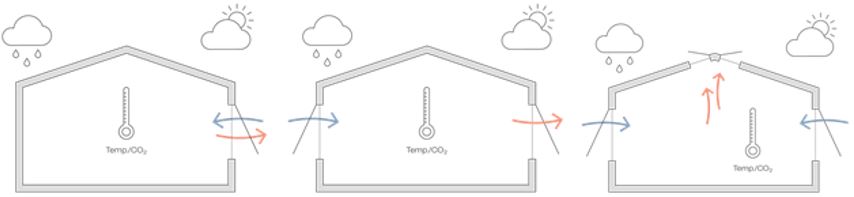
Natural ventilation: single-sided ventilation, cross ventilation and stack ventilation. Source: https://www.windowmaster.com/
Natural ventilation strategies depend on the design of the building, internal thermal loads, and the positioning of openings (typically windows). Natural ventilation can be single-sided ventilation, cross ventilation or stack ventilation, depending on the building's characteristics.
Additionally, for natural ventilation it can be used also windcatchers (traditional in Persian architecture), which generally have the form of small towers installed on top of buildings and draw air from outside into a building, providing natural ventialtion in hot, arid and humid areas.
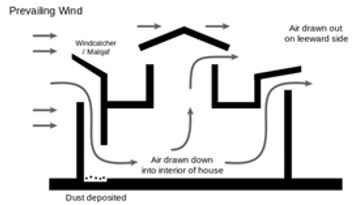
Windcatcher (for natural ventilation). Source: https://www.wikiwand.com/en/Windcatcher
Expected benefits are related to reduce the needs of mechanical ventilation, which leads to a reduction in the energy needs, as well as to a reduction of GHG emissions. It also contributes to improve air quality indoors, and it is related also to healthier and more attractive lifestyles; while leading as well to low future maintenance costs due to the lower need of mechanical systems.
Natural ventilation is directly linked to passive building design strategies (https://netzerocities.app/resource-194), as well as to other integrated solutions in buildings, e.g. joinery for low-energy houses (https://netzerocities.app/resource-184), envelope insulation (https://netzerocities.app/resource-154), green roof (https://netzerocities.app/resource-164), green walls and green façades (https://netzerocities.app/resource-174), climate-smart greenhouses (https://netzerocities.app/resource-276), Building Automation and Control Systems (https://netzerocities.app/resource-758), etc.
Climate and geography:
External conditions such as temperature, relative humidity and air quality will affect the potential for implementing natural ventilation in buildings. This generally means that extreme climates with high external air temperature and relative humidity have a lower potential to design with natural ventilation. The role that building design plays in the potential for natural ventilation, whether for new or existing building, is also essential. In temperate climates (as in Denmark, Norway, Germany, Switzerland, and most of the UK), the natural ventilation works quite well.… In climates with higher external temperatures or relative humidity, mixed mode ventilation (or hybrid ventilation) is an effective approach to get the best benefits of natural ventilation without compromising indoor air quality. In this mixed mode ventilation approach, the natural ventilation can be switched on or off depending on the outdoor conditions. This helps to ensure that the building performance requirements are met for both optimal comfort and energy savings. With respect to the windcatchers, they have limited application in regions with very low wind speed.
Urban form and layout:
External elements such as trees, adjacent buildings or other structures need to be considered since they may obstruct the wind.
Technical aspects/ infrastructure:
Almost all buildings can make use of passive ventilation, especially office buildings, schools, theatres and hospitals. Buildings should be oriented so that the windward wall is perpendicular to the summer wind (check out the wind rose map to determine the local prevailing wind direction). Thus, passive ventilation is easier to implement in new constructions, but it is also possible to integrate it in existing buildings, and to combine it with other systems already in place. The new passive system will complement the existing one to take advantage of the use of natural forces.
Natural ventilation is an effective way to reduce indoor temperatures and is one of the most important passive cooling strategies for buildings. For this purpose, it is essential that the architectural design considers the orientation of the building towards the prevailing winds and allows a double air circulation. This cross-ventilation improves air movement inside the dwelling and supports a more stable and comfortable indoor environment without additional energy demand.
Several factors affect natural ventilation (such as prevailing wind speed and direction, surrounding environment, building footprint and orientation, outdoor temperature and humidity, size, location and opening of windows), and proper design is key for natural ventilation to work and be effective.
As far as windcatchers are concerned, they may have some limitations: they may allow small animals, birds or insects to enter; the head of windcatchers is fixed and does not rotate with the direction of air flow; in areas with very low wind speed they have limited application.
Natural ventilation is often associated with the manual opening and closing of windows to renew and cool the indoor environment. While this is true, it is also possible to intelligently automate roof and facade openings to make life easier for the building occupant and to maintain the security of the building.
If natural ventilation is carried out manually, it can pose a threat to the security and integrity of the building. If an occupant leaves a window open, someone could illegally enter the building or rain could damage the interior. It can also contribute to uncomfortable draughts in the wintertime if not done properly.
This control is automatic in some cases, especially in mixed mode ventilation systems, which use sensors to monitor indoor temperature, CO2 levels, and humidity, as well as outdoor conditions. Based on this data, the system automatically selects natural ventilation or mechanical ventilation depending on which system is more optimal to use.
For monitoring in a specific building:
- Energy savings compared to reference building (without passive ventilation) or building energy consumption before the implementation of ventilation passive systems. [% of kWh/m2/year]
- GHG emissions reduction according to previous energy savings [% of CO2e]
DNHS, substantive assessment for:
Climate change mitigation: take into account that the implementation of the natural ventilation systems or mixed mode of ventilation system do not lead to a significant greenhouse gas emission on lifecycle basis.
Instruments related with the improvement of Energy Efficiency in buildings, as it is means to reduce building’s energy consumption by relying on natural forces, e.g.:
- User Engagement for Energy Performance Improvement: https://netzerocities.app/resource-14988
- Loans for Energy Efficiency (EE): https://netzerocities.app/resource-1648
- Blended finance for Energy Efficiency (EE): https://netzerocities.app/resource-1658
- Building Renovation Passport (BRP): https://netzerocities.app/resource-1748
- Turnkey Retrofit Service: https://netzerocities.app/resource-1843
- Analysis of City/ (Building) circularity: https://netzerocities.app/resource-1873
- One-stop-shop for building renovation: https://netzerocities.app/resource-1913
- User Engagement for Energy Performance Improvement: https://netzerocities.app/resource-1498
- City of Glasgow College (BREEAM Excellent building), architectural project, UK
- HouseZero, Harvard Center for Green Buildings and Cities (renovated building), CGBC Headquarters, UK
- UCL Student Centre at Gordon Street, London, UK, architectural project
- MECD – Manchester Engineering Campus Development, UK. Renewal of one of the UK’s most large-scale higher education projects.
- Augusta University Cancer Research Center, Georgia, USA. M. Bert Storey Research Building. Two building additions into the overall campus scheme
- Clayton Heights Community Centre, Surrey, British Columbia, Canada. Passive House project not residential building, project.
- Rocky Mountain Institute Innovation Center, Basalt, Colorado, USA. Green building design techniques, net-zero energy building, project.
Komentarai ()