
From the land use planning perspective, urban green spaces or urban green areas are defined by Corine Land Cover classification[1] as “Areas with vegetation within or partly embraced by urban fabric. This class is assigned for urban greenery, which usually has recreational or ornamental character and is usually accessible for the public, and can also include small water bodies. It includes parks, gardens, city squares with greenery, vegetated areas, cemetery with vegetation, green inner spaces of city blocks, ponds, lakes, small water bodies”.
However, instead of considering them as individual and disconnected green spots, all these green and blue areas can together form a green infrastructure whose roles and functions should be seen as an ecosystem.
As summarised by the European Environment Agency[2], “Green infrastructure is a strategically planned network of natural and semi-natural areas with other environmental features designed and managed to deliver a wide range of ecosystem services (as defined by the EC’s GI communication – COM/2013/0249final). Green infrastructure is present in both rural and urban settings. In urban areas, many different features may be part of green infrastructure (e.g. parks, gardens, grassy verges, green walls or green roofs) as far as they are part of an interconnected network and are delivering multiple ecosystem services. These green urban elements (or blue if aquatic ecosystems are concerned) may be found within the city and in its peri-urban area” (source: EEA, glossary of green infrastructure).
They are therefore relying on nature-based solutions. IUCN defines nature-based solutions as “actions to protect, sustainably manage, and restore natural and modified ecosystems that address societal challenges effectively and adaptively, simultaneously benefiting people and nature.”
Greening through the creation of urban green spaces can therefore provide multiple ecosystem services and is a response to the challenges of biodiversity and climate change. Climate change reinforces certain hazards that are already problematic in the urban environment: overheating in summer, extreme rainfall causing flooding by runoff on impermeable surfaces, etc. The physical and physiological properties of green spaces make it possible to limit certain hazards: shading and leaf transpiration for cooling are examples. Thus, greening is now recognised as a possible response to the challenges of biodiversity loss and climate change.
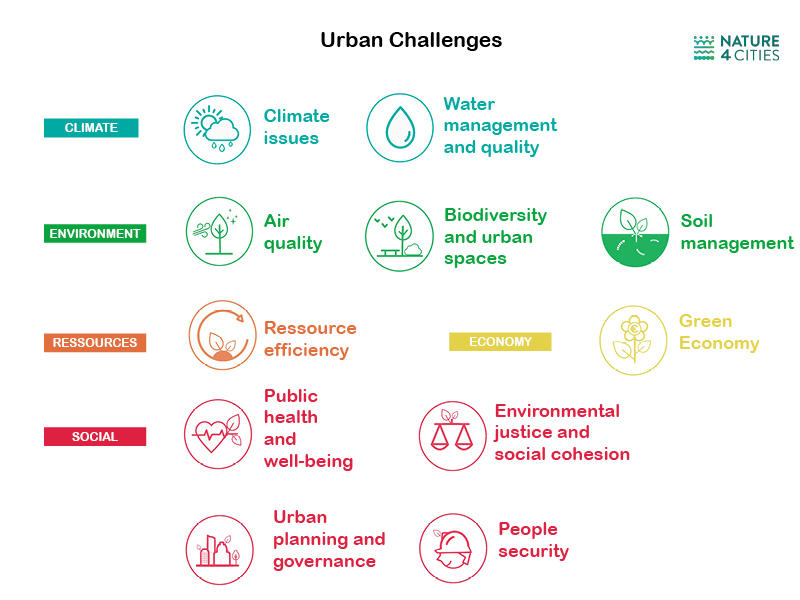
The purpose of this concept sheet is to highlight the role and functions of green and blue areas in cities as part of an ecosystem.
Kommentarer ()