
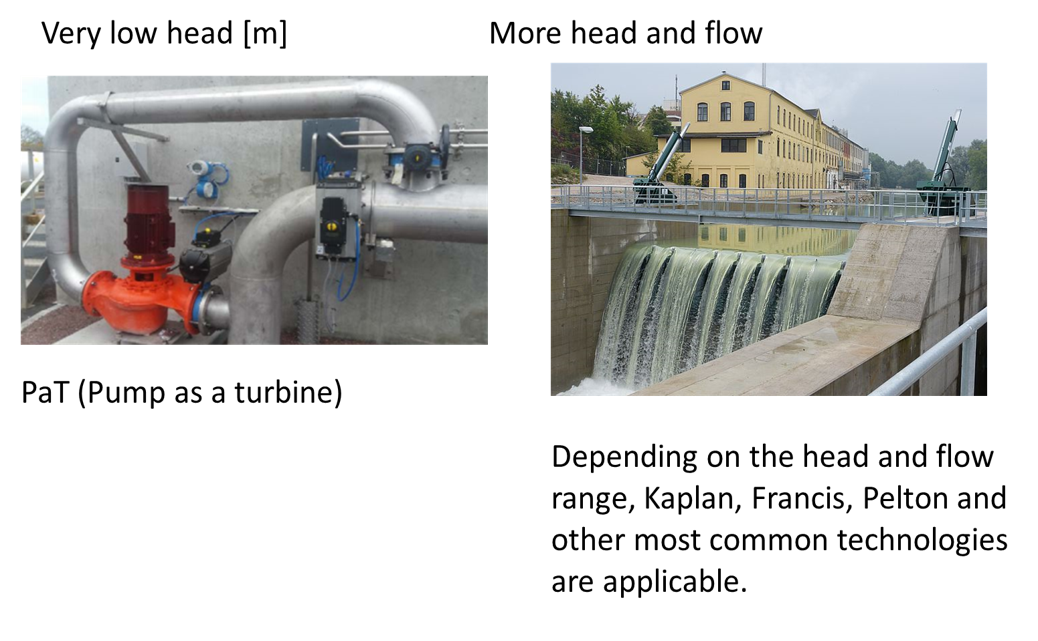
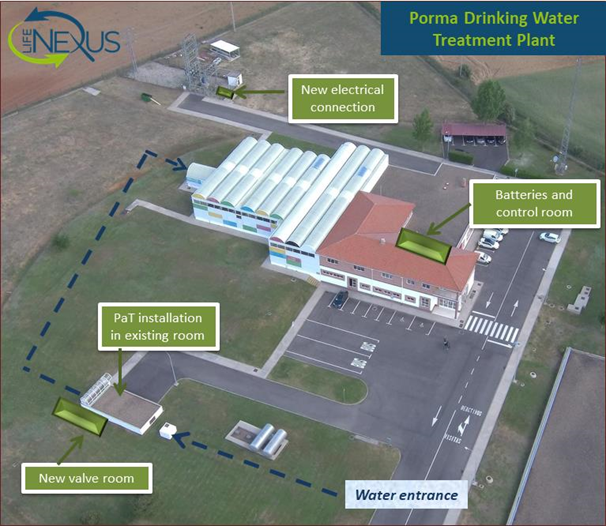
Cities are a framework where the water-energy nexus is becoming critical due to demographic movements, economic growth, or the inexorable increase in the demand for both resources. Metropolises around the world are also facing global change pressures due to climate change and water scarcity, which are making it a challenge to continue to deliver core urban water services without increasing the impact on the natural environment. Urban water networks can be considered a source of renewable energy as they usually hold untapped energy deriving from abundant pressure (water head) or kinetic energy (water flow). The sites with excess energy are located in existing storage/service reservoirs, wastewater systems (collection or discharge stages), or in devices already installed to alleviate the excess energy as pressure reducing values or Break pressure tanks. Micro-hydropower plants can be installed for generating "green electricity" using specially designed in-pipe turbines. Among the different available machines, Pump as Turbines are becoming the technological solution for micro-hydraulic projects. When more head (pressure) is available (i.e. there is a waterfall, even if it is small), other technologies such as Kaplan, Francis, or Pelton turbines can be used. Urban planners and water utilities must consider energy implications in decision-making on water systems and can consider this type of solution when defining or updating urban water strategies. The EU-funded LIFE NEXUS Project is mapping the energy recovery locations in European cities and has found that the potential hydropower capacity in more than 70 sites across Europe is about 3,000 MW.
Case studies can be found in a river, Grobweil, or in water networks (using pump-as-a turbine), Dwr Uisce.
Product life cycle stages & Modules (EN15978): D Energy recovery.
Kommentare ()