
The EU Waste framework directive (Directive 2018/851/EU) defines a target to recycle 65% of municipal waste by 2035, along with separate biowaste collection or recycling at source by 2023. Composting is a natural method of waste recycling whereby the organic waste, under natural or induced conditions, is converted into organic fertiliser or soil additives.
Community composting is a localised solution for recycling organic solids, wherein different waste generators from one or more urban housing societies, small restaurants and shops collaborate to compost organic waste at a specific site. The output compost is generally used as a fertiliser and for soil amendment in local parks and green spaces within the community area, or sold through municipal buy-back programmes. The main benefit of community composting is that it allows large quantity of organic waste to be managed at- or near-source, avoiding the waste to be diverted to landfills or transported for secondary processing. This in-turn reduces the cost of waste processing for the city, at the same time reducing the resultant carbon emissions from landfills.
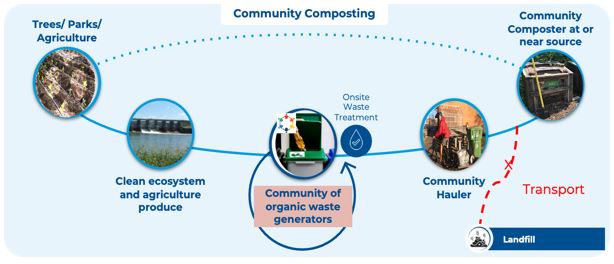
Cities may introduce policy and incentive measures to promote community composting by empanelling vendors, providing step-by-step guidelines, introducing compost buy-back programmes, incentivising and recognising communities undertaking community composting, and providing digital platforms for citizen to learn from and collaborate with one another.
- Climate mitigation: reduced carbon emissions (methane reduction) on account of the diverted organic waste from landfills and waste transport emissions;
- Climate adaptation: improved soil health, improved air, water and soil quality by replacing chemical fertilisers;
- Sharing ecomomy: worker- or people-owned structures can be used;
- Decreased costs: lower cost of waste transport and management for municipality;
- Social capacity building: increased (green) awareness and knowledge of environmental aspects of waste management;
- Citizen engagement: the entire process is citizen-led and creates social cohesion;
- Economic opportunities: green jobs and economic opportunities through the sale of compost;
- Better waste management: circular economy solution to on-site waste recycling and reuse;
- Sustainable and resilent food system: compost can be used to promote individual or community kitchen gardens, reducing dependency on external food supply; and
- Greater biodiversity: compost can also act as a feed for birds.
Community composting is directly related to solutions such as urban carbon sink, urban green areas, MSW treatment, MSW prevention, reduction of waste material, cooling trees, and circularity food cities.
Community Composting refers to an initiative undertaken to manage the waste generated by small and large households, by a group of people in a locality (ideally within the society premises or in a nearby shared area). This compost is then used as fertiliser for growing fruits and vegetables within the society or for parks and gardens within the community. The compost can also be sold to for instance garden centers to generate income for the community. Composting also benefits the environment as it reduces the amount of waste that reaches landfill sites
Climate and Geography:
Climatic conditions play a vital role in composting – particularly temperature, wind and rainfall, which influence the composting process. Higher temperatures kill pathogens; lower temperatures also slow down the decomposition process. Moisture content also impacts composting, taking more time for making compost in regions with more rainfall or in humid regions. Optimal conditions (in terms of right moisture ~40 to 60%) and temperatures (ideally between 40°C to 65°C) should be maintained for composting
Urban form and layout:
Community composting can be done at any designated site within a community. In a housing society, it can even be done on rooftops. The site should be in a covered area so that it is protected by rain. The site should also be properly fenced. The following factors should also be considered.
Elevated and away from water: an upland site away from water bodies with a gentle slope of about 2% that drains away.
Away from neighbours and with the wind: consider wind direction and downwind position to reduce odour concerns.
Away from high water tables: as this increases the potential for groundwater and surface water contamination if the site floods.
Protected from storm water runoff: use ramps, compost socks, ditches, and drains can redirect runoff.
Technical aspects/infrastructure:
Community composting can be done in many sites, including schools, colleges and residential societies. The planning of community composting depends on various parameters:
- Site selection: This is one of the most important parameters, and involves avoiding flood plains, consideration of prevailing winds, overall surrounding (land use) and consideration of inhabited areas.
- Access to the community composting site and role of public authorities: It is important to get permission from the authorised users and have initial validation, inspection and monitoring and data tracking done by them.
- Land Ownership: whether the land is public or private.
- Maximum Capacity: Capacity of compost bins depends on the size of the community.
- Materials used for decomposition: This depends on the waste decomposed from household, garden, park or agriculture.
- Operator: This depends on the number of people involved (e.g. manager, composter, technician).
- Community Composting Participation: It is important to spread awareness among the people living in the composting area.
- Compost use: After the decomposition and treatment of waste, the manure can be used in parks, gardens and agriculture as a fertilizer for growing of trees.
Policy and regulatory/legal framework:
Community composting needs to be carefully planned out, in accordance with urban planning principles, and put into practice using a comprehensive approach. The primary goals of EU strategy are effective waste management and selective waste management. Therefore, community composting cannot succeed without the support of an enabling policy environment. Coordination between all stakeholders – including the national and municipal governments, NGOs, financiers, and the private sector – is necessary to ensure that policies are aligned to support composters.
Funding and Financing:
The development of a compost plan at the community level is not a very high investment. Communities can allocate a portion of their waste management funds to the activity. They can also generate revenue from the sale of compost which can be used for its operations. The community will also save on buying compost from outside for maintenance of their parks and gardens and funds can be used for maintenance of the compost plant. In schools and colleges, this can be used as an awareness for students. The system can be created from infrastructure development funds of institutions, and students can contribute to actually maintaining the compost plant. Savings on account of transportation costs to the city can be used as a financing instrument for such projects.
Economic and social context:
Community composting requires support from all in the community for its effective functioning. Communities must be aware of the benefits of composting. In schools and colleges, this can raise awareness for the younger generation on proper management of their waste, positively benefiting the future.
Project Governance and Implementation modalities [1]:
For the successful operation of the system, it is important that it is regularly maintained and monitored by welfare associations, communities, operators or persons-in-charge. Governments and community groups can implement compost sites for yard trimmings and food scraps. Local compost sites provide a low-cost way to collect and compost food scraps. These sites can be managed by non-profits and volunteers. Local and regional governments can provide loans and contracts to non-profits for community composting. It should have strong waste collection and disposal mechanism systems. The implementation steps are:
- Identification of suitable land;
- Identification of suitable mechanism based on the geographical and climatic conditions of the area;
- Development of a proper waste disposal mechanism;
- Preparation of a proper Operational Plan; and
- Undertaking awareness programmes.
[1] Community Composting: A Practical Guide for Local Management of Biowaste (Zero Waste Europe, 2019)
Climate and geography:
The climatic conditions of an area will impact the time taken for the decomposition of waste. Composting is a four-phase process characterised by changing temperatures: initial (mesophilic) phase (25–40 °C), thermophilic phase (35–65 °C), cooling (second-mesophilic) phase, and maturation phase. Temperature controls microbial activity. 40–65 °C is ideal for composting.
Technical aspects/infrastructure:
The disadvantages of composting by-products include the cost of site preparation and equipment, the lengthy treatment period, the final use of the compost product, and environmental issues such as odours and dust. Some investment in equipment and site preparation is required or recommended. Composting is a slow process that can take several weeks to complete depending on the technique used. The determination of a suitable market for compost is critical to justify the extra effort in producing compost. Composting is a biological process that, if not properly managed, can result in significant odour generation. Because of the slow release nature of nutrients in compost, higher application rates are required to achieve the same plant response as the original by-product. Higher application rates require more material and more trips across the field than the original by-product.
Economic and social context:
The limited awareness about community composting and its importance to the environment may create an issue among communities. Food scraps can be thrown in the yard waste bin if citizens are aware of three things:
The value of composting;
How to compost; and
What can be composted.
Barriers include the notion that composting takes a lot of time in the absence of a formalised household system to collect food scraps, and the low priority given to composting. People who don’t compost may also be worried about pests or unpleasant odours. The operation of composting requires full-time involvement of operators to effectively manage the system.
Policy and Regulatory/Legal Framework:
Since governmental support for community composting programmes is frequently insufficient, public encouragement and involvement are crucial. Public knowledge and technical proficiency should be well-established in this regard. National legislation on community composting should serve as the primary guide when creating a decentralised composting framework, especially when selecting pilot sites and reactor systems to reduce potential negative environmental effects.
Climate and Geography:
Community composting can be implemented anywhere, but climate plays a vital role as it both increases the time of decomposition and increases the cost of technologies that are required to be implemented in cold and humid, and hot and humid areas. Compost pile temperatures affect microbial growth and decomposition rate. Higher temperatures accelerate organic material breakdown, kill weed seeds, and kill pathogens. Extreme heat (>70 °C) inhibits microbial activity. The optimal temperature range is 40 °C to 65 °C. Using a thermometer, the composting temperature can be adjusted as needed. Aeration, turning, and changing pile moisture and size are common temperature-adjusting methods.
Economic and social context:
Poor management can lead to uncontrolled degradation of organic waste in containers, causing odours and leachate. Furthermore, logistic problems can lead to unsatisfactory implementations. New composting technologies should be well-addressed, and operational environment data should be thoroughly analysed for a win-win situation for all stakeholders.
- Community Composting: A Practical Guide for Local Management of Biowaste (Zero Waste Europe)
- Growing local fertility: A guide to community composting (ILSR)
Emissions:
Composting reduces greenhouse gas emissions and food waste. Food loss and waste account for 8–10% of global greenhouse gas emissions.
Although EC (2010) reported significant methane and ammonia emissions for in-vessel composting, Andersen et al. (2012) report negligible ammonia emissions and variable methane emissions of 0.4–4.2 kg per tonne of wet Organic Household Waste (OHW). These emissions are highly dependent on process management and can be minimised under best practice. Considering the net impact on account of fertiliser replacement, avoided transport and adding carbon to soil. Community composting leads to relatively minor net burdens and a significant fossil resource depletion of -359 MJ equivalent per wet tonne of OHW composted if the avoidance of waste collection is considered. (Home and community composting- JRC, EC, 2022)
Cost:
The total investment can be divided among houses based on society's unit needs. Per household investment (a) Marketing & Literature: EUR 6; Net Bin Cost: EUR 3.38; Delivery and storage: EUR 14.86; Annualized Cost: EUR 2.50 (over 10 years)
DNSH:
Pollution prevention and control:
Mixed organic waste can lead to the presence of tiny plastic particles in the compost, which will have a negative effect on its quality and, if used as manure (fertilisers) for food and vegetables, will degrade the quality of the soil. Additionally, if a compost pile is improperly aerated (anaerobic), which means oxygen isn't reaching the pile, it will emit methane gas harmful to the environment
- Smart waste: pay-as-you-throw (https://netzerocities.app/resource-2169)
- Reducing demand for (over)packaging/ packaging waste, improved circular design and strategies that fully replace the need for packaging (https://netzerocities.app/resource-2453)
- Capacity building for city officials to understand urban metabolisms and circular solution opportunities (https://netzerocities.app/resource-1568)
Case Studies:
- Case Study community composting in San Francisco (US)
- Home and Community composting in Porto (Portugal)
- Community composting in the city of Nitra (Interreg Europe)
Case Study community composting in San Francisco (USA)
San Francisco was the first US city to require composting. San Francisco adopted a 75% diversion by 2010 and zero waste goal in 2002. It exceeded the first goal two years early, recovering 80% and halving disposal. LA Compost started in 2013. First, volunteers collected "organics" on bicycles. Restaurants and juice bars composted food scraps at community members' homes. Funds from sales or donations at local farmers' markets went to school gardens. LA Compost launched local hubs in 2014. Each hub keeps organics in the community and offers a space to learn about composting. Local grants and businesses like Patagonia helped LA Compost expand. The community diverted over 360,000 kg of organics in 2021.
Home and Community composting in Porto (Portugal)
Terra à Terra promotes home composting in Lipor's municipalities to reduce organic waste. About 500,000 tons a year of municipal waste from Lipor's affiliated municipalities are collected, transported, treated, and disposed of. This involves: 13,905 composting bins distributed (1 per household/ institution); 75 composting sites; 4,020 composting site and kitchen waste bucket support visits. Lipor conducted an online survey about the kitchen waste bucket in 2014. This method estimates bio-waste reduction per compost bin: 423 kg/compost bin per year, translating to 5 886 tons per year bio-waste reduction, 1,237 tonnes CO2 per year. Gardens and urban farming use compost.
Community composting in Nitra (Slovakia)
Community Composting in Nitra, Slovakia, was launched in 2018 as a small-scale project for 50 households, whose final product – compost – serves involved households and public areas. Composting Community's project. Nitra Community Foundation's first grant was 4,000 EUR (3,000 for composter and 1,000 for promotion and composting accessories). Voluntary work has no costs. In 2020, another grant (1,000 EUR) funded lectures and guidelines. The city of Nitra began cooperating in 2020, and new composter sites were identified in 2021. The city is deploying 40 new composters. As part of informal environmental education, the city plans composting lectures.
Komentáře ()