
Co-generation is the simultaneous production of electricity and useful heat. In a regular power plant, the heat remaining in the generation of electricity is released to the environment, mostly through cooling towers or cooling water, whereas in a cogeneration plant, the heat is recovered for use in homes, businesses, and industry.
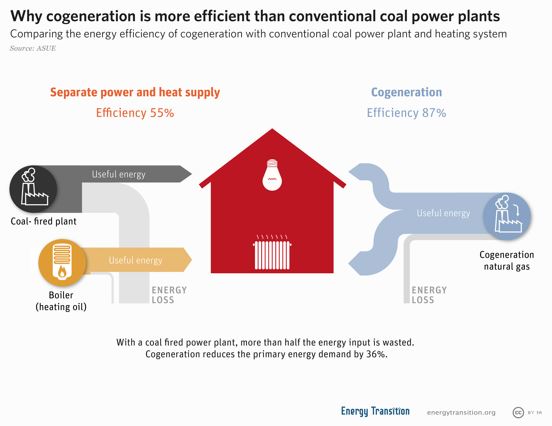
Source: Energy transition - Cogeneration (https://wiki.energytransition.org/wiki/cogeneration/)
Such a system has valuable properties to enhance the efficiency of fuel use: the combined production of electricity and heat turns out to be more efficient than the separate production of these two forms of energy. Cogeneration plants can achieve energy efficiency levels of around 90%.
All types of power plants can become cogeneration systems (e.g. steam power plants, gas turbines, combined cycle power plants, internal combustion engines) while the extracted heat largely varies in entity and temperature depending on technology, size, and operation parameters. The specific advantage of using steam turbines in comparison with the other prime movers is the option for using a wide variety of conventional as well as alternative fuels such as biomass or hydrogen. Gas turbine cogeneration has probably experienced the most rapid development in recent years due to the rapid progress in technology, a significant reduction in installation costs, and better environmental performance.
Because of the higher efficiency of cogeneration systems, they reduce GHG emissions in comparison to the conventional technologies and therefore improve air quality.
Co-generation systems, also known as combined heat and power (CHP) systems, are highly efficient systems that generate both electricity and thermal energy from a single fuel source. The pre-conditions and enabling conditions for co-generation systems are as follows:
Climate and Geography:
The climatic conditions play an important role in the design and operation of co-generation systems. The case of the paper industry in Italy shows that the availability of biomass resources, such as forest residues and agricultural waste, is a key enabling condition for co-generation systems. The presence of natural assets, such as rivers, also plays a crucial role in the operation of hydroelectric power plants, which are a form of co-generation.
Urban Form and Layout:
The size and layout of cities can affect the design and operation of co-generation systems. Highly populated areas with high energy demands are ideal locations for co-generation systems. For example, highly-energy intensive industries within city boundaries, such as the paper industry, can benefit greatly from co-generation systems.
Technical Aspects/Infrastructure:
The existing city infrastructure and local R&I infrastructure play an important role in the deployment of co-generation systems. The availability of enabling digital and data infrastructures, such as ICT, IoT, big data analytics, and environmental monitoring, can help optimize the performance of co-generation systems. The availability of a reliable electricity grid infrastructure is also a key enabling condition. The case of Jämtkraft's biomass CHP plant in Östersund, Sweden, shows that usable surface areas for biomass storage and handling are important pre-conditions for biomass-based co-generation systems.
Policy and Regulatory/Legal Framework:
The policy and regulatory/legal framework can either enable or hinder the deployment of co-generation systems. Relevant EU/national laws, standards, and regulations should support the deployment of co-generation systems. Strategic alignment with regional/national objectives can also be an enabling condition. The availability of funding and financing options, such as the Just Transition Fund and the European City Facility (EUCF), can also be an enabling condition.
Funding and Financing:
Funding and financing are crucial enabling conditions for the deployment of co-generation systems. Fiscal decentralization and own resources, incentives, subsidies, availability of private capital, access to EU funding, and innovation procurement are all important funding and financing options. Blended finance for energy efficiency and loans for energy efficiency can also be used to fund co-generation projects.
Economic and Social Context:
The economic and social context can also affect the deployment of co-generation systems. Demographics, GDP per capita, cost of take-up, digital divide vs inclusion, citizen awareness, education, and digital skills are all important factors to consider.
Project Governance and Implementation Modalities:
The models of public services design and delivery, including engagement and participation of citizens and local private/public stakeholders, citizen-engagement and co-creation initiatives, stakeholder consultation, public-private partnerships, experimentation/testing needs, contracting of services including maintenance, and implementation by citizens/private companies are all crucial factors in the successful deployment of co-generation systems.
In conclusion, the deployment of co-generation systems requires a combination of pre-conditions and enabling conditions. The availability of natural assets, such as biomass resources and rivers, along with a reliable electricity grid infrastructure and usable surface areas for biomass storage and handling, are key pre-conditions. The policy and regulatory/legal framework should support the deployment of co-generation systems, and funding and financing options should be available. The economic and social context and project governance and implementation modalities should also be considered in the successful deployment of co-generation systems.
Climate and geography:
High variability in climatic conditions, including fluctuations in temperature, humidity, and wind speed, can affect the efficiency of cogeneration systems.
The availability and accessibility of natural resources, such as biomass and water, can be limited in certain geographic locations.
Urban form and layout:
The size and layout of urban areas can affect the availability of usable surface areas for the installation of cogeneration systems.
Land use regulations and zoning laws may restrict the installation of cogeneration systems in certain areas.
Technical aspects/infrastructure:
Existing city infrastructure, including electricity grid infrastructure, may not be able to accommodate the increased demand for electricity and heat from cogeneration systems.
The lack of interoperability and standards across different systems and technologies can create technical difficulties and limit the scalability of cogeneration systems.
Highly energy-intensive industries within city boundaries can compete for resources and limit the availability of feedstocks for cogeneration systems.
Policy and regulatory/legal framework:
The absence of clear and consistent regulatory frameworks can create uncertainty and deter investors from financing cogeneration projects.
Decentralization of state powers can create a lack of coordination and consistency in energy policy and regulation across different regions and municipalities.
Data policies, including restrictions on data sharing and access, can limit the ability of stakeholders to collaborate and develop innovative solutions.
Funding and financing:
The availability of private capital for financing cogeneration projects can be limited due to high upfront costs and long payback periods.
The lack of clear and consistent incentives and subsidies for cogeneration systems can create uncertainty and deter investors from financing these projects.
The limited access to EU funding and innovation procurement can also limit the availability of funding for cogeneration projects.
Economic and social context:
The cost of take-up for cogeneration systems can be high in relation to GDP per capita, making it difficult for some households and businesses to adopt these systems.
The digital divide and lack of digital skills and awareness can limit the ability of some stakeholders to participate in the development and implementation of cogeneration projects.
Project governance and implementation modalities:
The lack of engagement and participation of citizens and local private/public stakeholders can limit the knowledge and skills available for the development and implementation of cogeneration projects.
The lack of coordination and collaboration among different stakeholders can create conflicts and delays in the implementation of cogeneration projects.
The lack of experimentation and testing of different solutions can limit the ability of stakeholders to identify and implement the most effective and efficient cogeneration systems.
Overall, overcoming these barriers will require a combination of policy and regulatory reforms, innovative financing mechanisms, technical solutions, and stakeholder engagement and collaboration. By addressing these barriers, it may be possible to unlock the full potential of cogeneration systems and achieve greater energy efficiency, cost savings, and environmental sustainability.
Pros:
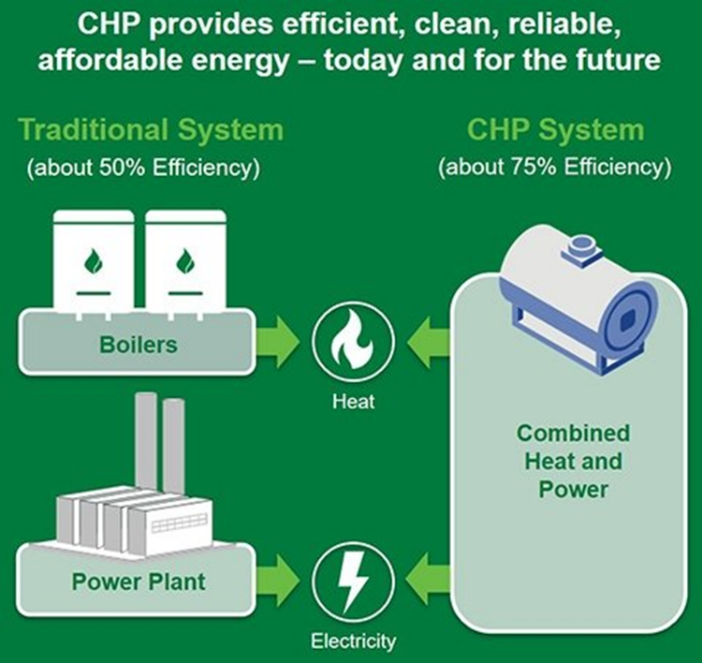
Increased efficiency: Cogeneration systems are more efficient than traditional power plants because they use the waste heat generated during electricity production to provide heating or cooling, which would otherwise be wasted.
Reduced energy costs: Because cogeneration systems use waste heat, they can help reduce overall energy costs by reducing the amount of electricity and heat that needs to be purchased from external sources.
Improved environmental performance: Cogeneration systems produce less greenhouse gas emissions than traditional power plants, which helps reduce environmental impact and can make them more attractive to environmentally conscious consumers.
Enhanced energy security: Cogeneration systems can help improve energy security by providing on-site generation of electricity and heat, reducing reliance on external sources.
Versatility: Cogeneration systems can be used in a variety of settings, including residential, commercial, and industrial applications.
Cons:
High initial investment costs: Cogeneration systems typically require a significant upfront investment, which may be a barrier to adoption for some organizations.
Maintenance and repair costs: Cogeneration systems require ongoing maintenance and repair to ensure optimal performance, which can be costly.
Technical challenges: Designing, installing, and operating cogeneration systems can be complex and may require specialized expertise.
Limited applicability: Cogeneration systems may not be suitable for all applications or settings, as their efficiency is highly dependent on the specific use case.
Potential environmental impact: While cogeneration systems can reduce greenhouse gas emissions, they may still have a negative environmental impact if not designed and operated properly.
Overall, cogeneration systems have the potential to provide significant benefits in terms of energy efficiency, cost savings, and environmental performance. However, their implementation may be limited by the high initial investment costs, technical challenges, and maintenance requirements. Careful planning and ongoing attention to system design and operation are critical to realizing the full benefits of cogeneration systems while minimizing their potential drawbacks.
- High-Efficiency Cogeneration Systems: The Case of the Paper Industry in ITaly
- Cogeneration: https://beeindia.gov.in/sites/default/files/2Ch7.pdf
- An introduction to Power Plant Cogeneration (CED engineering)
-
Jämtkraft reveal plans for a new biomass CHP plant in Östersund (Bioenergy International)
-
Production of Sustainable Paper with cogeneration (COGEN World Coalition)
-
Cogeneration turbines help fire up sustainable paper production (Baker Hughes)
The values of co-generation systems for the indicators listed can vary depending on the specific system and its operating conditions. However, here are some approximate values:
Power absorption (kW): This will depend on the size of the co-generation system and the amount of electricity it is designed to produce. For example, a small co-generation system designed to power a single home might have a power absorption of around 5 kW, while a larger system designed to power a commercial building could have a power absorption of several hundred kW.
Coefficient of Performance (COP): The COP of a co-generation system will depend on the type of system and the operating conditions, but a typical value for a well-designed system is around 0.7 to 1.0.
Thermal efficiency (%): Again, this will depend on the system, but a typical thermal efficiency for a co-generation system is around 80-90%.
Electrical efficiency (%): The electrical efficiency of a co-generation system is typically in the range of 20-30%.
Fuel consumption (L/h): The fuel consumption of a co-generation system will depend on the type of fuel used, the size of the system, and the operating conditions. For example, a small natural gas-fired co-generation system might have a fuel consumption of around 0.2-0.3 L/h, while a larger system powered by diesel might consume several litters of fuel per hour.
Total heat generated (kW): The total heat generated by a co-generation system will depend on the size of the system and the operating conditions, but a typical value might be in the range of 80-90% of the system's total output. So, for example, a 100 kW co-generation system might generate around 80-90 kW of heat.
Benefits from achieved indicators:
- Emissions of GHG from the production and processing of energy per unit of energy output (tons CO2e/MWh or tons CO2e/MJ or CO2e/m2)
- GHG emissions reduction (e.g., by replacing an energy-hungry system with the solution in object) per unit of energy output (tons CO2e/MWh or tons CO2e/MJ or CO2e/m2)
- GHG emissions avoidance (e.g., by removing the need for energy consumption or by reducing the trip length) (%CO2e)
- Energy consumption per unit of end-use activity (kWh/m2/y)
- Energy savings compared to reference building (% kWh/m2/y)
- Total capital requirements per unit of energy output or installed capacity (EUR/MW or EUR/MJ)
- Total capital requirements per unit of output (EUR/unit)
- Total annual operational costs per unit of energy output (EUR/MWh or EUR/MJ)
- Total annual operational costs per unit or per energy output (EUR/unit or EUR/MJ)
- It is important to note that the impact of co-generation systems can be difficult to quantify as it is often context-specific and depends on a number of other factors. Therefore, it is recommended to provide a range of values or a narrative of the expected impact if a quantification is not possible.
In addition, the DNSH principle should be considered to ensure that the co-generation systems do not cause significant harm to the environment. For instance, any activity that leads to significant greenhouse gas emissions on a lifecycle basis should be avoided.
Funding and financing: Horizon Europe, NER 300 programme
(Funding for innovative low-carbon technology research with focus on environmentally safe Carbon Capture and Storage and innovative renewable energy technologies), European Climate Infrastructure and Environment Executive Agency (CINEA), European structural and investment funds (ESIF), LIFE, Prize for renewable energy islands, Horizon 2020 dashboard (Access to real-time programme data with the ability to filter by country, region, theme and more).
Additional examples of co-generation systems from case studies:
The University of British Columbia (UBC) in Vancouver, Canada has a co-generation system that produces 12 MW of electricity and 26 MW of thermal energy using natural gas as fuel. This system provides electricity and heat for the campus, reducing greenhouse gas emissions by 22,000 tonnes annually.
The Burj Khalifa in Dubai, the tallest building in the world, has a co-generation system that uses waste heat from the air conditioning system to generate electricity and provide hot water. This system reduces the building's energy consumption by 15% and saves approximately 6,000 tonnes of carbon emissions annually.
The Boston Medical Centre in Massachusetts, USA has a co-generation system that produces 2 MW of electricity and 4 MW of thermal energy using natural gas as fuel. This system provides electricity and heat for the hospital and its surrounding neighbourhood, reducing greenhouse gas emissions by 16,000 tonnes annually.
The St. Olav's Hospital in Trondheim, Norway has a co-generation system that produces 7 MW of electricity and 16 MW of thermal energy using natural gas as fuel. This system provides electricity and heat for the hospital and the neighbouring university, reducing greenhouse gas emissions by 12,000 tonnes annually.
Links to resources on co-generation systems from case studies:
- Case Studies on Cogeneration Projects in Thailand: https://www.osti.gov/biblio/750437-case-studies-cogeneration-projects-thailand
- Cogeneration Case Studies: Efficiency in Energy and Environment: https://www.bundesverband-kwk.de/fileadmin/media/downloads/BWK-Broschueren/2010_Cogeneration_Case_Studies.pdf
- Case Study of Cogeneration System Installed in a Hospital: https://www.ijert.org/research/case-study-of-cogeneration-system-installed-in-a-hospital-IJERTV7IS110270.pdf
- Cogeneration Case Studies in the Hospitality Industry: https://www.energy.gov/eere/amo/downloads/cogeneration-case-studies-hospitality-industry
- Cogeneration case study - Sainsbury's Dartmouth: https://www.theade.co.uk/resources/cogeneration-case-study-sainsburys-dartmouth
Yorumlar ()