
The built environment makes up almost a third of global greenhouse gas emissions and the embedded emissions of materials used in construction are contributing greatly to this. Concrete alone is responsible for 4 to 8% of the world’s CO2. Circularity in the built environment and the use of biobased materials can play a significant role in reducing cities’ carbon emissions.
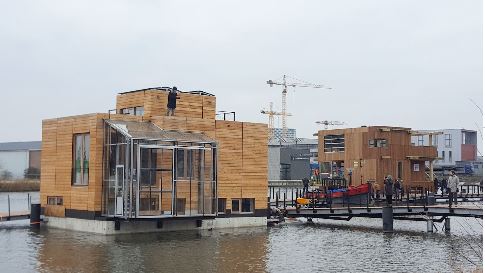
Schoonschip: A sustainable floating neighborhood. Source: https://www.metabolic.nl/projects/schoonschip/
Concrete that already exists in our urban environments can be reused after being removed from buildings, for example as a foundational layer underneath roads. However, urban mining alone will not suffice to build sustainable cities. Based on research by Metabolic and the EIB, it can facilitate roughly 30% of the materials needed to build the cities of tomorrow.
Biobased materials, which are derived from renewable organic matter (biomass) of plants or animal origin, provide an alternative to concrete. These materials include woods, hemp, straw, cellulose wadding, or recycled textiles. Bricks made from compressed earth can offer a climate-smart alternative to traditional bricks, as they do not require baking and therefore have a low energy footprint. They also provide an opportunity for cities to adapt to rising temperatures, as the compressed soil helps to regulate humidity and capture heat which is slowly released at night.
Kommentarer ()