
As cities around the world are growing, we need to find new ways to feed growing urban populations. Our current linear food system is wasteful, inefficient, and resource-intensive. Roughly a third of the food produced worldwide is wasted and ends up in landfills, creating harmful greenhouse gas emissions. Cities (and their peri-urban regions) can take on a leading role in creating sustainable and circular food systems with better waste management. Closed-loop food systems not only decrease food waste and pressure on the environment. They also decrease the need for new production (food loss), leading to enhanced resource utilization reusing and/or recycling by-products of the food and feed production systems.
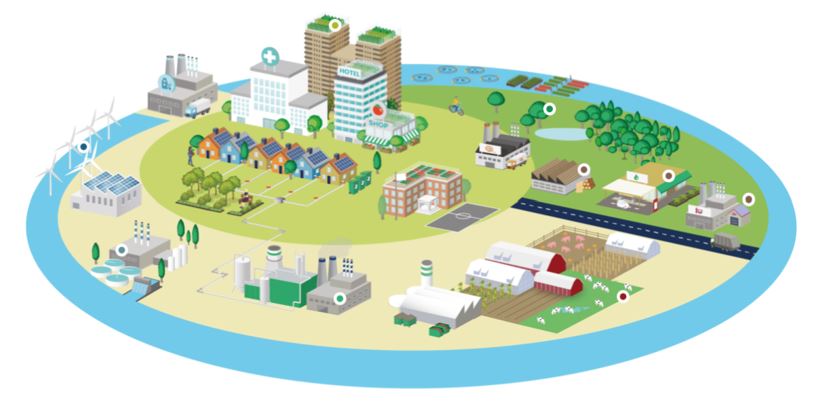
Source: Metabolic Institute
To design and implement circular food systems it is important to first assess food-related flows going into and leaving the city. Urban Metabolism Mapping can help to better understand these flows. Another important step towards circular flows in the food industry is the implementation of regenerative agriculture practices. Also, in order to reduce losses, it is necessary to know how the waste is generated, either food waste or human waste. Valuable nutrients and chemicals can be extracted and then used as fertilizers, plastic, chemical or textile feedstock, food compounds, or for animal feed.
Product life cycle stages & Modules (EN15978): Full value chain
Kommentare ()