
Cities’ metabolism is the process of converting material inputs into outputs. Urban metabolism mapping is a method of quantifying and visualizing all the energy and material flows entering the city to meet the needs of the city and assessing how these materials are either stored or transformed and how they are exiting the city.
Transitioning from the prevalent linear urban metabolism to a circular urban metabolism is essential to achieve environmental sustainability. The current linear metabolism converts resources into waste that is discharged into the environment. A circular metabolism allows for better resource use efficiency. To design waste out of our urban systems, a clear understanding of current material flows is essential. Urban metabolism mapping practices can help cities in their attempt to identify product streams and material inputs and thereby establish a clear picture of the urban material flows. From there, more in-depth analysis can be conducted and circular interventions can be designed and implemented to promote closed-loop systems.
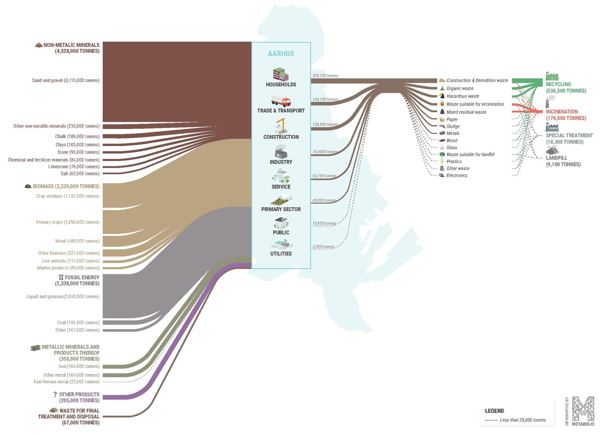
Source: Metabolic
A commonly used practice to assess these streams is by conducting a Material Flow Analysis. Using this approach, the materials flowing into the urban system, the stocks within the system, and the outputs are identified and can be visualized by means of e.g. Sankey diagrams.
Komentarai ()