
The natural and built environment that surrounds us largely dictates our behaviours. When it comes to transportation, the domination of the streetscape by car-lanes naturally leads to higher car ownership and use. To address this challenge, the development of well-connected green corridors can promote a modal shift away from cars and towards sustainable mobility means, whether this is walking, cycling or micromobility.
Instead of concrete/asphalt roads with little to no vegetation, green corridors essentially comprise a linear routes, street, pathway infrastructure, which use a series of swales, rain gardens, street trees, and pervious pavement to create a cooler oasis and promote active mobility. In the case of green corridor, routes and pathways can integrate asphalt, stabilising materials, etc. with different impacts in terms of carbon footprint and comfort (including practicability for people in wheelchairs or with walking difficulties).
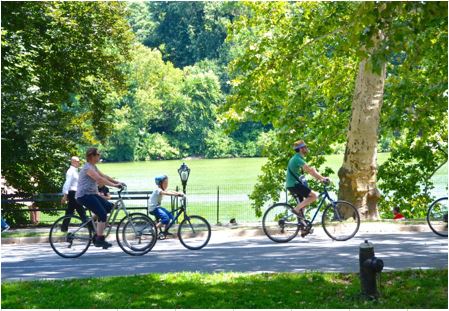
Source: centralpark.com
Green corridors can go as far as to form a green network which can connect neighborhoods, parks and other open spaces. They can design to offer comfort and safety, while offering opportunities for physical exercise and promoting well-being. Green corridors are also key contributors to social equity, considering that they provide equitable access as opposed to car ownership.
In terms of mitigation, green corridors contribute to GHG emissions reduction and air quality improvement thanks to the modal shift they encourage.
In terms of adaptation, green corridors can reduce the heat urban island, due to a greater presence of vegetation and water. They can reduce the risk of flooding, by reducing run-off water. Lastly, hard surfaces can make use of pervious materials or high albedo materials to further decrease temperature increase. Green Corridors offer significant co-benefits when carefully designed (improving air quality, enhancing biodiversity, better well-being and health).
Comentarii ()